
Introduction
Hey everyone, I'm Oil. This guide walks through the DeepSeek team's architectural write-up Super-agent Design Exploration: Toward More Autonomous Agent Systems.
Many readers open the original post and bounce off dense systems jargon—Sequence Points, Prefill batching, Fast/Slow Paths, Inline & Spill, Speculative Execution, full-duplex loops, compute-storage separation, and external Control Loops. Strip away the OS terminology, though, and every single mechanism addresses an everyday pain point of running real AI Agents.
Let's walk section by section through what each mechanism does and the concrete problem it solves.
1. Multi-Task Fatigue & How Super-agent Differs
1. The Single-Session Bottleneck: Human Attention Runs Out First
Single-task Agents (Claude Code, Codex, Antigravity) already execute individual scoped jobs reliably. Today's bottleneck is no longer whether one task succeeds—it's human attention collapsing across parallel tasks.
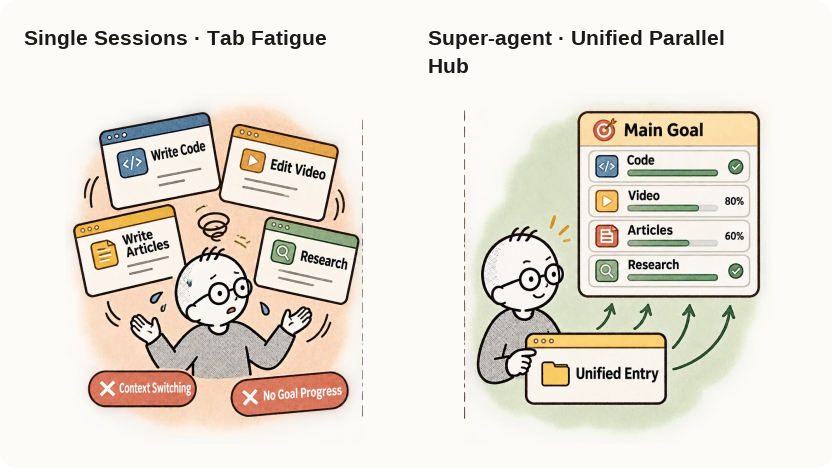
On a typical day, I juggle coding, video creation, writing guides, and technical research across multiple Agents. Because today's Agents center on isolated Sessions (individual chat windows), two headaches emerge fast:
- Constant window-switching fatigue: As DeepSeek notes, humans cap out around 3–5 concurrent threads—single-task output is bounded by model capability, while multi-task throughput is bounded by human attention.
- Zero unified status or overarching goal tracking: Across seven open tabs, you have to click each one manually to see what's finished, running, or stuck—and only your own head remembers how they fit the larger goal.
DeepSeek's Super-agent aims for four traits simultaneously: Continuous (one coherent Agent across Lark, GitHub PRs, etc.), Efficient (fast replies + parallel heavy execution), Proactive (monitors events and acts when warranted, stays silent otherwise), and Persistent (always-on, connected to real environments, self-healing).
Five interlocking system layers make all four possible: Router/Worker layering, event-driven filtering & recall, human-centric async UX, compute/state/BYOM separation, and an external Watchdog.
2. What It Fixes Over Existing Personal Agents
Open-source local gateways like OpenClaw and newer assistants (Meta's Muse, OpenAI's Dots, Manus's Cue) share this 24/7 always-on direction (OpenClaw already has a main session, sessions_spawn, Skills, and Discord sub-thread binding, and OpenAI's Dots can control local sessions alongside cloud sandboxes). Yet in practice, wiring a chat gateway to call local coding Agents hits three recurring snags:

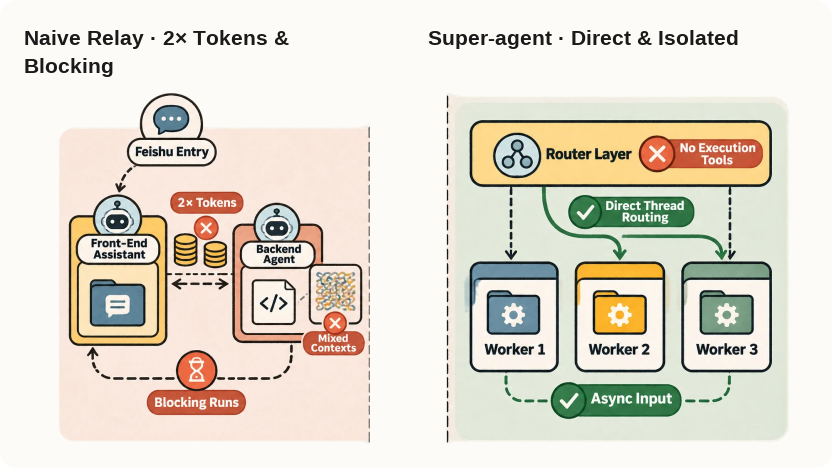
- Double token burn from cross-layer relaying: Every follow-up gets read and summarized by the outer gateway and the inner coding Agent.
- Blocking during long runs: Hard to chime in or pivot cleanly mid-execution.
- Context cross-contamination: Mixing code, scripts, and writing in one entry thread without hard architectural boundaries quickly pollutes memory.
2. Two-Layer Router & Worker Architecture
1. Splitting Router from Worker
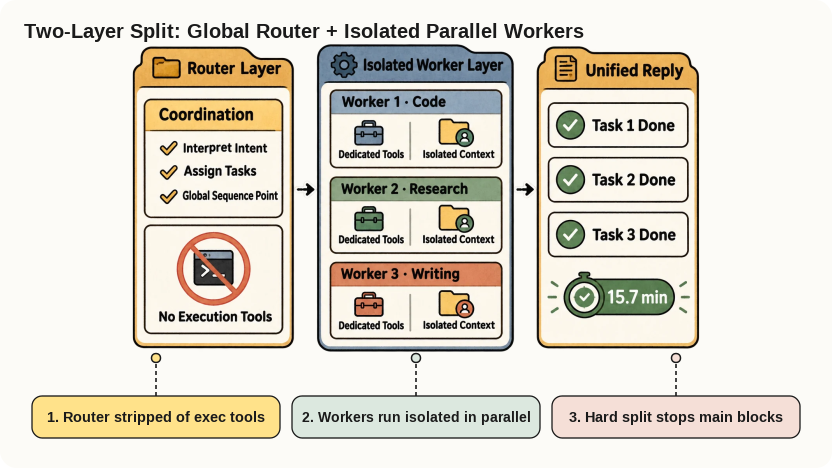
One shared Session preserves continuity but serializes everything; spawning an isolated Session per message parallelizes fast but shatters global memory. DeepSeek solves this with a strict two-layer split—treating Sessions as internal plumbing rather than user burden:
- Resident
Routerlayer (Global Memory & Sequence Point): Receives all human interactions across Lark, GitHub, etc., ordering cross-channel decisions cleanly. Crucially, the Router is physically stripped of execution tools (no Bash) so it can never get stuck running heavy work—it only routes and communicates, which also means it can run on a lighter, faster model. Unlike an Agent Team lead micromanaging one task's sub-steps, the Router manages cross-task coordination without touching internal task execution. - Isolated
Workerlayer (Parallel Heavy Lifting): Runs full coding/file tools on top models in isolated contexts, never talking directly to humans—returning only concise results to the Router (mirroring How to Use Subagents Effectively). Each Worker can also spawn its own internal subagents or Agent Team transparently to the Router.
Why Prompts Alone Can't Enforce Delegation
In my own testing, models differ noticeably in delegation discipline (Claude delegates to subagents proactively, while GPT tends to work directly in the main window). DeepSeek's Section 7.1 benchmark (~300 mixed messages + 20 real tasks across 5 runs) proved why prompting an all-in-one Agent to "delegate to subagents" fails:
- Plain prompt: Delegated 0 out of 5 runs—main window blocked repeatedly,
p95latency 29.5 min. - Strict "always delegate" prompt: Delegated 4/5 runs, yet on run 5 decided "this looks small" and blocked the main thread anyway.
- Architectural Router/Worker split (no execution tools on Router): Forced 100% delegation—
p95dropped cleanly to 15.7 min.
2. Router Auto-Batching & Prefill Parallelism
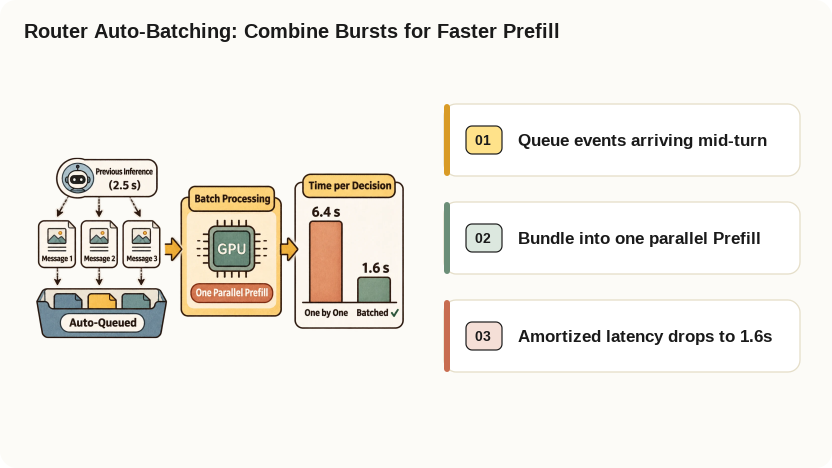
Won't a single Router bottleneck during busy group chats? No—thanks to Auto-Batching plus LLM Prefill parallelism (see LLM Fundamentals: Attention & KV Cache):
- While Router spends ~2.5s processing one event, 3 new messages arrive; instead of queuing 3 separate calls, it bundles all 3 into the next single input.
- Reading inputs (Prefill) runs in parallel on GPUs, while generating outputs (Decode) is sequential—and Router outputs only a few tiny dispatch lines.
- In DeepSeek's Section 7.2 stress test, jumping from 1 to 40 events/min grew average batch size from
1.0to2.8while single-call latency rose only from 2.5s to 3.9s. More importantly, handling a single event typically takes 2–3 consecutive model+tool turns totaling 6.4s, whereas batching multiple queued events into one loop drops amortized decision latency per event from 6.4s down to 1.6s—meaning a single Router does not need premature sharding at normal team scale.
3. Event-Driven Routing & Context Governance
1. Two-Stage Event Filtering (Fast Path / Slow Path)
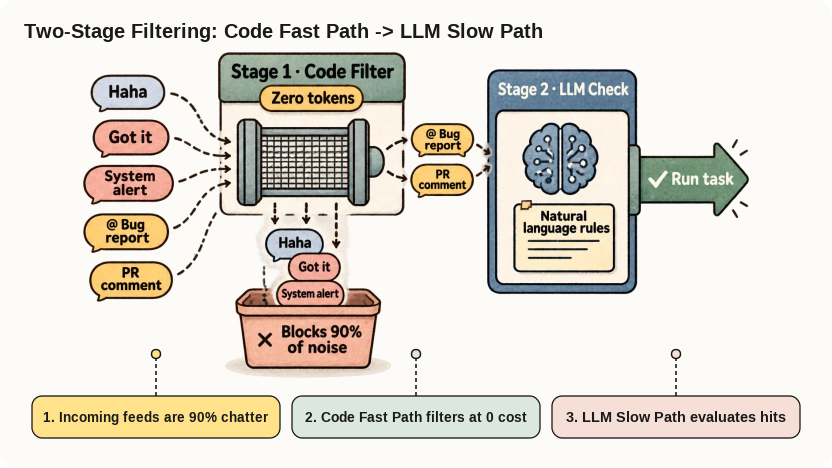
Over 90% of work-chat traffic is casual chatter. DeepSeek splits triage in two:
- Code
Fast Path(0 tokens): Millisecond rules check channel, sender allowlist, and explicit triggers—classifying each channel as "explicit requests only," "candidate event," or "ignore," dropping noise for free. - Semantic
Slow Path(LLM): Evaluates only surviving candidate events against natural-language user rules editable without code deploys.
2. Thread Subscription (Fast Path Direct Routing)
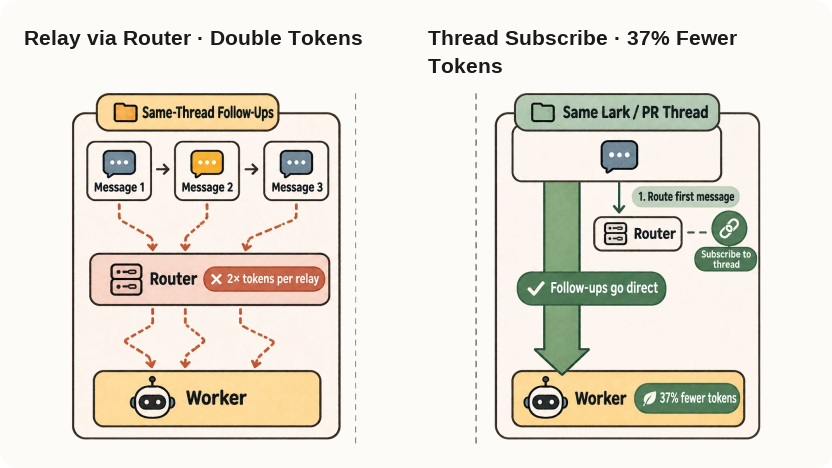
Once Router spins up a Worker for a Lark thread or GitHub PR, the Worker subscribes directly to that Thread ID. Follow-up replies bypass Router straight into the Worker (if scope shifts, Worker unsubscribes back to Router). In DeepSeek's Section 7.1 ablation, direct thread routing cut Router decisions by ~30% and saved ~37% of KV Cache replay tokens (31.77M → 23.23M). Many-to-many subscriptions also let two Workers touching the same PR notify each other and resolve conflicts automatically.
3. Inline & Spill + Chain of Recall
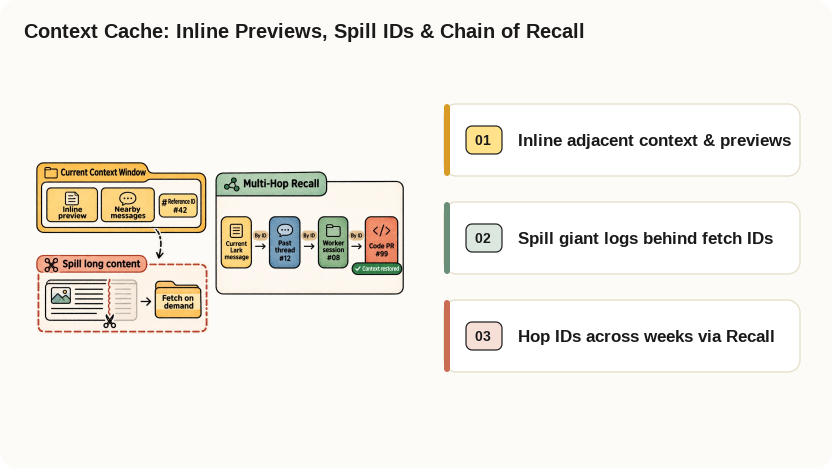
To keep long-lived memory sharp without blowing up context:
Inline: Auto-attach tight neighboring context (replied message, adjacent messages, linked IDs + 50-char previews) so the model rarely needs extra lookup calls.Spill: Hard-cap giant docs or logs—keep a short preview + unique ID in context, fetch full content on demand.- Chain of Recall: Every Trigger, Thread, and Worker carries an ID, and every fetched object follows
Inline & Spillwith next-hop IDs—letting Router hopmessage → Thread #12 → Worker #08 → PR #99across weeks in 2–3 quick calls.
4. Speculative Execution: Try Silently, Ship Only When Valid
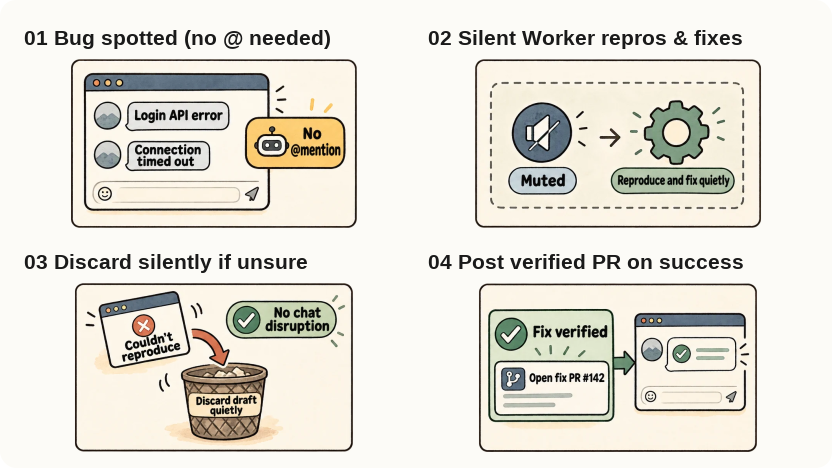
Borrowed from CPU design: when someone mentions a bug in chat (without @-mentioning the Agent), a background Worker quietly attempts to reproduce and fix it. If it fails or looks risky, it discards the draft in total silence (zero spam); only when the fix is verified and ready to merge does it post a PR link.
4. Full-Duplex Async UX & Multi-Channel Output Rules
1. Async start/stop ReAct Loop (True Full-Duplex)
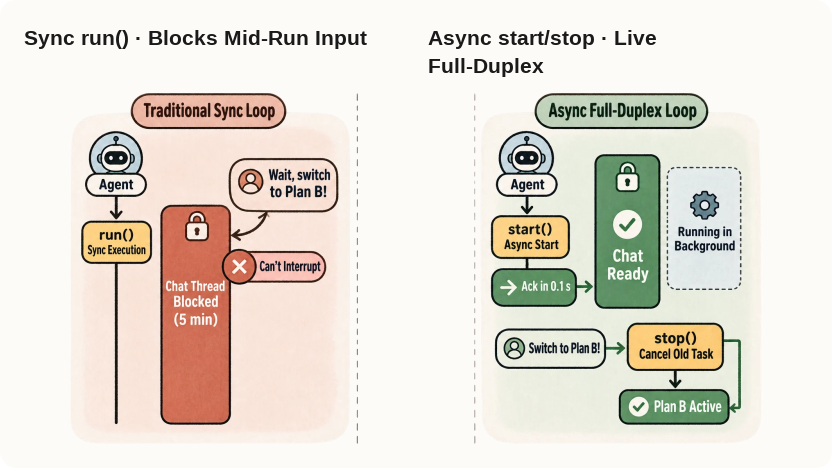
Mid-run messaging breaks down into three tiers:
Queue: Holds your message until the entire multi-step run finishes.Steer(step-boundary interrupt, as in Codex and Claude Code): Injects between tool steps, yet because LLM APIs require every tool call to return a tool result before continuing, a 10-minute synchronous shell test still leaves your message stuck inPending Steeruntil that command finishes.- Async
start/stopFull-Duplex (similar in spirit to Claude Code'srun_in_backgroundand Antigravity's background tasks): Splits blockingrun()into instantstart()andstop()across three steps:
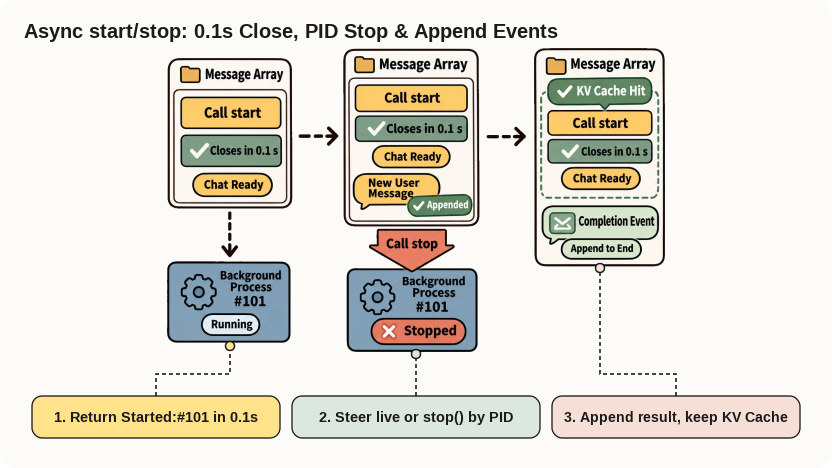
start("run full tests")spawns a background process (#101,PID) and returns"Started: #101"in 0.1s, freeing the chat box immediately.- Mid-run, you can ask side questions while tests keep running—or pivot, triggering
stop("#101"). - On completion, results append as a brand-new event at the end of
messages[]—never mutating earlier messages, preservingKV Cache. (DeepSeek notes this async mechanism is implemented in DeepSeek Harness, though not enabled by default yet.)
2. Channel-Adapted Output Rules
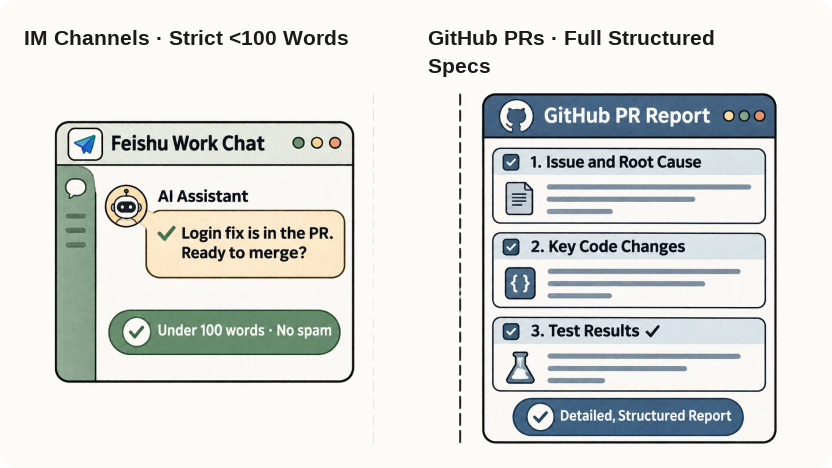
Worker logs stay hidden internally; Router enforces channel norms—strictly under 100 words in Lark/IM chats to avoid spam, versus full structured specs and test reports on GitHub PRs and email.
5. Compute/State/BYOM Separation & External Watchdog
1. Cloud Always-On + Local Lightweight daemon (BYOM)
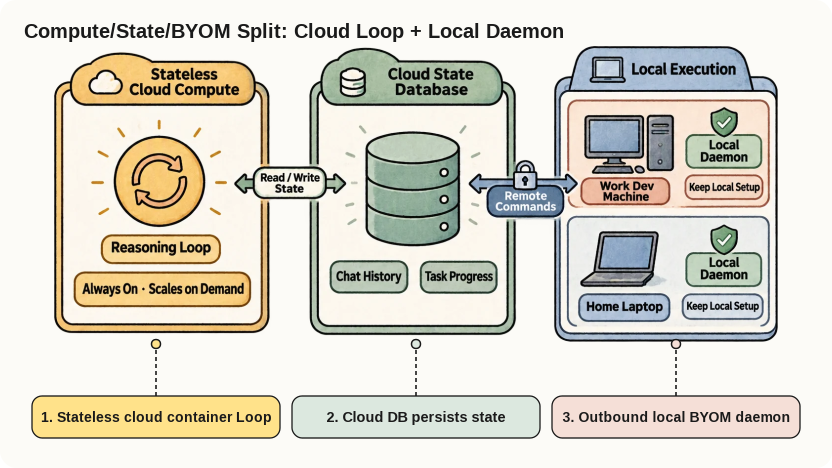
Two layers of separation keep the Agent online 24/7 while still operating your real local environment:
- Compute vs. State: Stateless elastic cloud containers run the
Agent Loop; cloud DB stores history and task state. - Cloud Loop vs. Local Environment (
BYOM— Bring Your Own Machine): A tiny statelessdaemonon your laptop (no LLM reasoning, onlyread/writeandbash/start/stop) initiates an outbound encrypted persistent connection (WebSocket/gRPC + heartbeats) to the cloud—requiring zero public IP on home Wi-Fi or corporate LANs. Close your lid, state stays alive in the cloud; reopen it,daemonreconnects and resumes right where it left off.
2. External Watchdog Control Loop
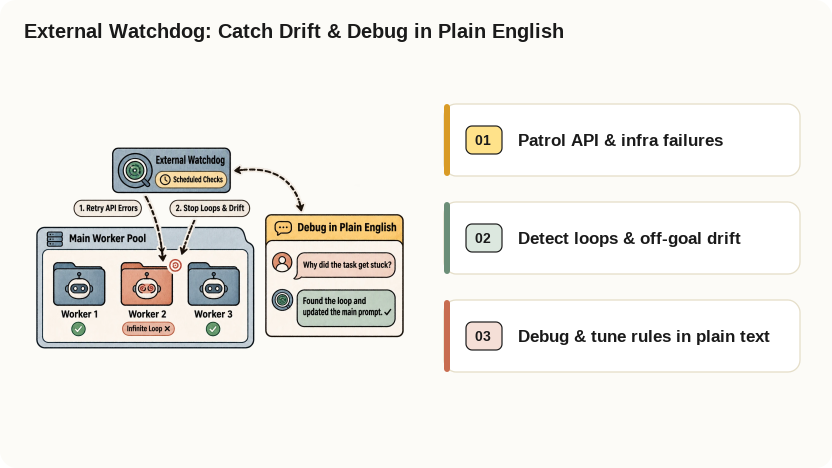
Traditional monitors only spot crashed processes—not live Workers stuck in pointless loops or drifting off-goal. A scheduled independent Watchdog Session (itself an LLM Agent) checks both infra errors and semantic progress—and lets operators simply ask in plain English "why did that task stall?" or update rules live.
6. Four Open Problems Ahead
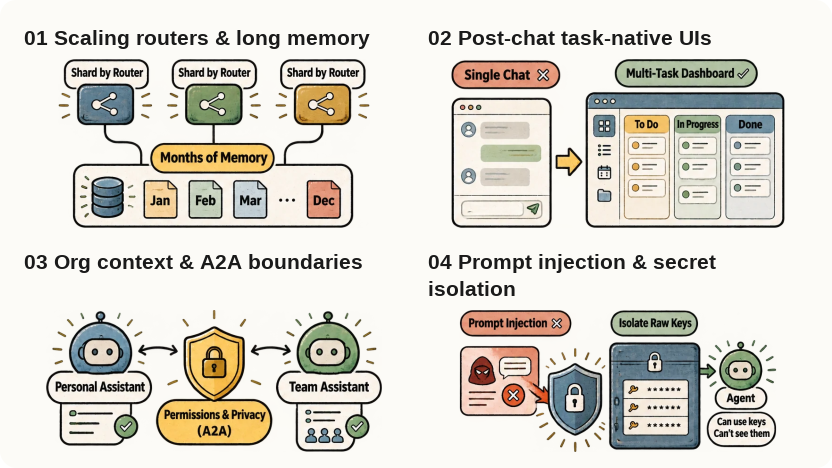
DeepSeek candidly flags four unsolved frontiers:
- Horizontal scaling & multi-month memory beyond small-team volumes.
- Post-chat UIs: Moving beyond chatboxes into domain-native boards, PR workflows, and smooth mid-run human takeover.
- Organizational context boundaries & Agent-to-Agent (A2A) collaboration without leaking private context.
- Cross-device security: Defending BYOM local daemons against Prompt Injection and keeping plaintext credentials completely outside LLM context.
Summary
DeepSeek's prototype (dsh-superagent-prototype) brings proven systems design into Agent engineering: architectural Router/Worker isolation over fragile prompts, balancing proactivity with zero spam via Fast Path + Inline/Spill + Speculative Execution + async full-duplex loops, and—much like Anthropic standardizing Skill—giving the industry a shared vocabulary and engineering reference for autonomous Agents.