
Introduction
Hey everyone, I'm Oil. This guide walks through becoming an AI Product Manager from 0 to 1—my two career transitions, how daily PM work inside AI startups differs completely from traditional companies, the technical and AI literacy you need, and how to ship your first personal AI app and land interviews directly with founders even with zero AI experience on paper.
To me, "AI Product Manager" means two things at once: using AI to work differently (drafting docs, designing, even coding live interactive prototypes directly in the repo) and owning AI products (understanding model strengths, limits, and engineering mechanics deeply enough to turn raw capability into real user value).
How I Transitioned into AI Product Management
1. From Frontend Developer to Traditional PM
Fresh out of college—after running a student web/mini-program studio—I started as a frontend engineer. Before long, implementing static mockups and routine CRUD screens felt narrow; I wanted to sit closer to product decisions.
Because I actively joined PRD reviews and spoke up on interaction flaws—and already thought in reusable components, which helped me pick up Figma component libraries quickly—I volunteered when my company (API7.ai, a cloud-native API gateway vendor with zero AI business despite the .ai domain) needed someone to step into product.
2. Zero AI Resume to Three AI Startups in One Year
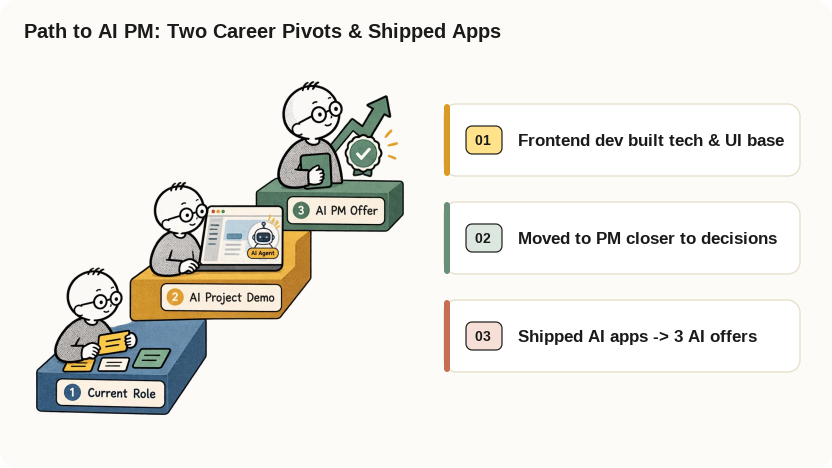
Product management heavily rewards prior domain proof, and my infrastructure background carried zero weight for AI roles. What broke the deadlock was building real personal AI tools—a flashcard app ("Study Cardbox"), "Text Well", and AI Werewolf (wolfcha)—and sharing the process publicly online. That portfolio landed me roles at three AI application startups in a single year: SuperMagic (general AI Agent), OpenCreator (AIGC canvas), and MuseOn (overseas marketing Agent).

AI Startups vs. Traditional Product Teams
1. Traditional PM Workflow: PRDs, Static Wireframes & Handoffs
In a traditional company, you gather requests, write a long PRD, draw static wireframes, and walk UI and engineering through them. Then you wait for visual mockups, hold a kickoff meeting, queue into a sprint, run QA, and finally ship—even the initial alignment and two review rounds easily burn 1–3 weeks.
2. AI Startup Workflow: Live Preview PRs Straight on Production Code
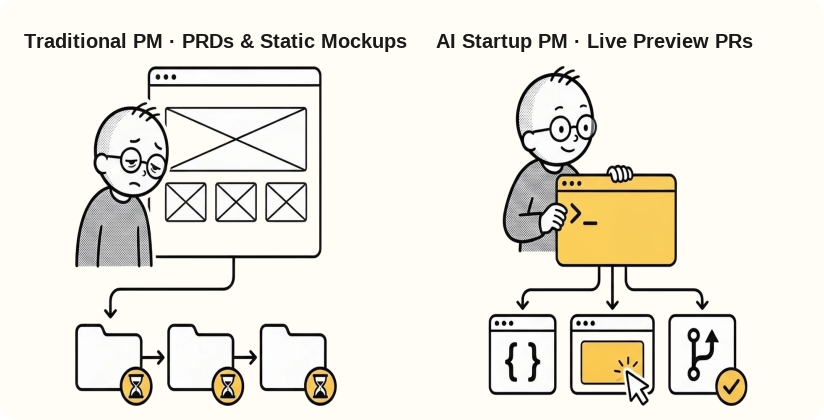
In AI startups, after defining the product flow, I Vibe Code the interactive UI directly inside the real repo and push a live Vercel preview link. Counterintuitively, building directly on top of existing repo components is easier and far higher-fidelity than drawing static wireframes from scratch. Once the team reviews the live preview, we merge the PR and ship—bringing in a backend engineer only for heavy database schemas or performance-critical backend architecture.
3. From "T-Shaped" to "Block-Shaped" Talent
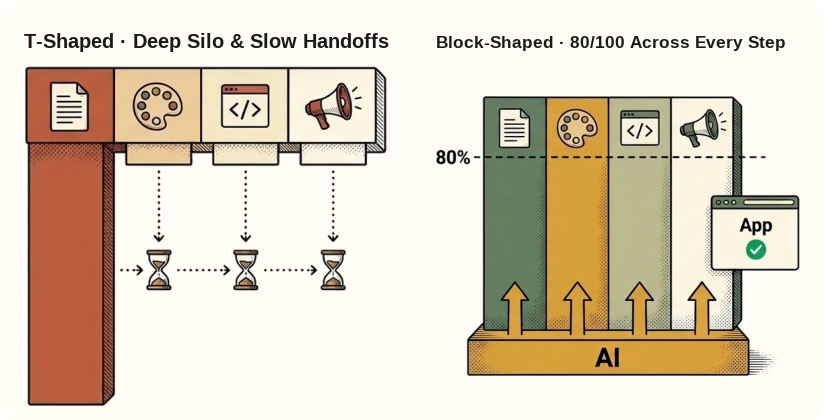
AI raises the floor across disciplines. What AI-native teams prize most now is "block-shaped" builders capable of delivering 80/100 execution across product sense, visual taste, live Vibe Coding, and public distribution.
What You Need to Learn—and How to Learn It
1. Why an AI PM Cannot Be Technically Clueless
Suppose you're designing an "AI slide generator": should it render HTML slides or generate native .pptx files? If you don't even understand what HTML can and cannot do, you cannot make credible product calls.
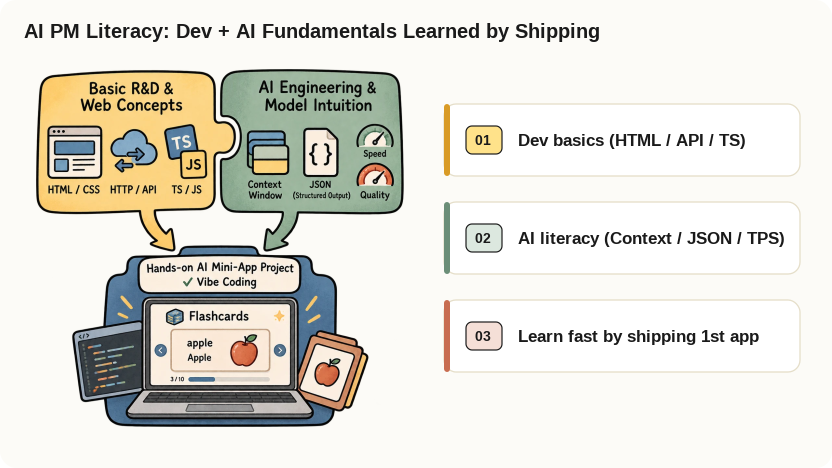
2. Two Core Knowledge Pillars
(For a structured refresher on both, pair with Core Engineering & AI Concepts for Vibe Coding.)
- Core engineering literacy: Common stacks and UI libraries, SSR, HTTP/HTTPS, JS vs. TS, components and functions.
- AI engineering & model feel: Context engineering, tool design, Agent workflows (Choosing an AI Agent & Environment Setup), TPS, API parameters, streaming, JSON structured output—plus hands-on intuition for which models shine at design, coding, natural prose, or cost.
3. Learn by Shipping One Real AI App
Skip memorizing textbooks. Calling LLMs in a chatbox and wrapping LLMs into a real user-facing product teach completely different lessons. Debugging API parameters, strict JSON schemas, and response latency while shipping your own small app locks every concept in permanently.
Shipping Your First Personal AI Product
1. Start with a Practical Personal Utility ("Study Cardbox")
Pick a real itch of your own. My first AI app was an Anki-style flashcard mini-program ("Study Cardbox"): front-and-back cards that extracted unknown words from articles, generated CET-4 vocabulary decks by topic, and built multiple-choice and fill-in-the-blank quizzes. Before building it, I didn't even realize LLMs are stateless until I inspected raw API request bodies myself—and wiring early DeepSeek V3 into it to compare speed, quality, and cost gave me real intuition across models. It picked up over 1,000 organic users in its first two days before search access was paused on day three over personal ICP filing (dropping to ~10 users by the time filing cleared), yet it taught me the full 0-to-1 AI app loop.

2. Layer In Thoughtful Product Craft ("Text Well")
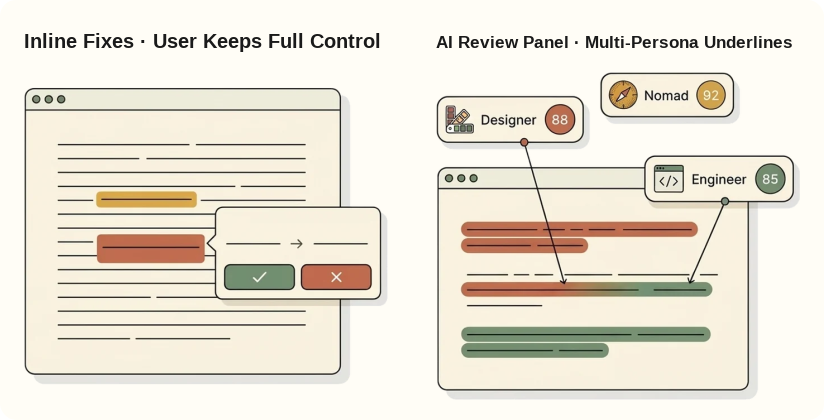
Born from writing long PRDs, Text Well avoided both tedious error lists and heavy-handed full rewrites by highlighting exact inline issues with one-click Accept/Ignore, then adding a playful "AI Review Panel" (three dynamic personas—industrial designer, digital nomad, software engineer—whose overlapping highlights render dual-color gradient underlines). Model speed was part of UX too: users won't sit around for 3–4 minutes waiting for feedback to finish, so I benchmarked models specifically for fast generation. Those multi-persona latency and speech-preloading lessons later carried straight into our two-day hackathon project AI Werewolf (wolfcha).
3. The Hidden ROI of Personal Products
Neither app paid the bills in subscription revenue—yet posting a short demo of Text Well to just a few hundred followers caught an AI startup founder's eye who had referenced it while building a similar feature, directly landing my first AI PM offer. A product you built yourself is the strongest resume you can show.